
Contractor lead response time: how to measure it and get under a minute
A practical way for home service companies to measure how fast they really answer new leads, find where leads die, and build a response system that works at night and on weekends.
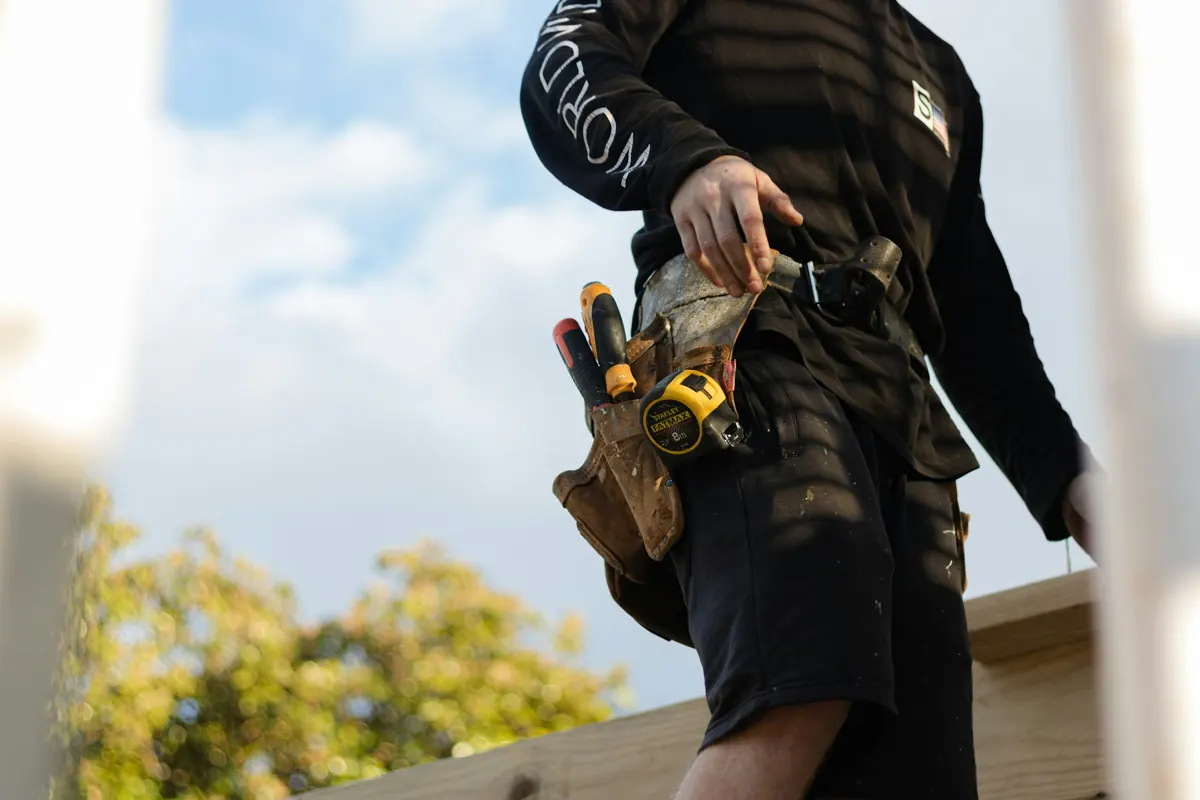
Contractor wearing a leather tool belt with a tape measure. Illustrative photo: Inky Hills / Unsplash
Lead response time is the time between a homeowner reaching out (a form, a call, a message) and your first real contact with them. For most home service companies the honest answer is “it depends who is in the office”. The goal is a consistent response in under a minute, at any hour, with a person ready to take over when the homeowner wants to talk.
This guide is the practical companion to our speed to lead field guide.
Step 1. Measure it for real
You can’t fix what you don’t measure, and the number in your head is usually optimistic. Run three tests this week:
- Form test at night. Fill out your own website form at 9 PM with a number your team doesn’t know. Write down the time of the first text, the first call and the first real conversation.
- Missed call test. Call your main line during a busy hour and hang up before anyone answers. See if anyone calls back, and when.
- Weekend test. Repeat the form test on a Saturday.
Write the three results down. That is your real response time.
Step 2. Find where leads die
Most leads don’t die because nobody cared. They die in predictable places:
- After hours. Forms that come in at night wait until morning.
- One attempt. Someone calls once, hits voicemail, and moves on.
- The busy office. The person who answers new leads is also scheduling crews and handling billing.
- No owner. Everyone thinks someone else called.
- Missed calls. A homeowner calls, nobody answers, and nobody texts back.
Step 3. Set your standard
Write it down so everyone knows it:
| Moment | Standard |
|---|---|
| New form or message | Text and email in under 60 seconds, every time |
| First call | Within the first minute when possible, always within 5 |
| Missed call | Automatic text back immediately, call back within 10 minutes |
| No answer | At least 5 touches over the next week (calls and texts) |
| Booked | Confirmation right away, reminder the day before and the same day |
Step 4. Automate the first minute
No team can call every lead in under a minute at 9 PM on a Sunday. Automation can:
- Instant text and email with your company name and a way to book.
- Missed call text back so no call goes unanswered.
- An automated or AI call that confirms the basics and offers times.
- An alert to your team when the homeowner wants a person.
The automation buys you the first minute. Your people do the conversation that matters.
Step 5. Follow up like you mean it
Many homeowners don’t answer the first call because they are at work, driving or putting kids to bed. A simple follow-up sequence (calls and texts across several days) recovers a lot of them. The key is that it runs on its own, so it never depends on someone remembering.
Step 6. Track three numbers every week
- Time to first contact for each new lead.
- Schedule rate: booked appointments ÷ leads.
- Show rate: sit-downs ÷ booked appointments.
If schedule rate is low, look at speed and follow-up. If show rate is low, look at confirmations and reminders.
Or let someone run it for you
This is the system Booked Contractor installs and runs for $1M+ home service companies, with the ads included. You pay only when the homeowner sits down with your team. See how it works.
Related: Speed to lead field guide · Exclusive vs shared leads

David Sierra is the founder of Booked Contractor. In 10+ years of digital marketing and lead generation he has worked with 300+ clients, generated thousands of qualified sales calls and invested more than US$30M in ads.